Belts and Promotions
Many questions come up surrounding the topic of belts and promotions, so we’ve laid out everything you need to know about how things are done in jiu-jitsu, and at Delta BJJ specifically.
-
There are 5 main belt ranks for adults (aged 16+). In order, they are: White, Blue, Purple, Brown, and Black.
Brand new students start at White Belt. Each student earns stripes on their belt to indicate their progress towards the next rank. Once a student has received 4 stripes, their next promotion will be to the next belt rank.
Some gyms ditch the stripe system altogether, but we feel it helps give the students a clearer idea of where they are on their journey towards the next belt rank. -
Unlike most traditional martial arts, jiu-jitsu traditionally promotes students based on skill, knowledge, and readiness - not formal testing. Testing is a demonstration of knowledge, but we want our students to be able to properly apply that knowledge dynamically, and effectively, against a resisting opponent.
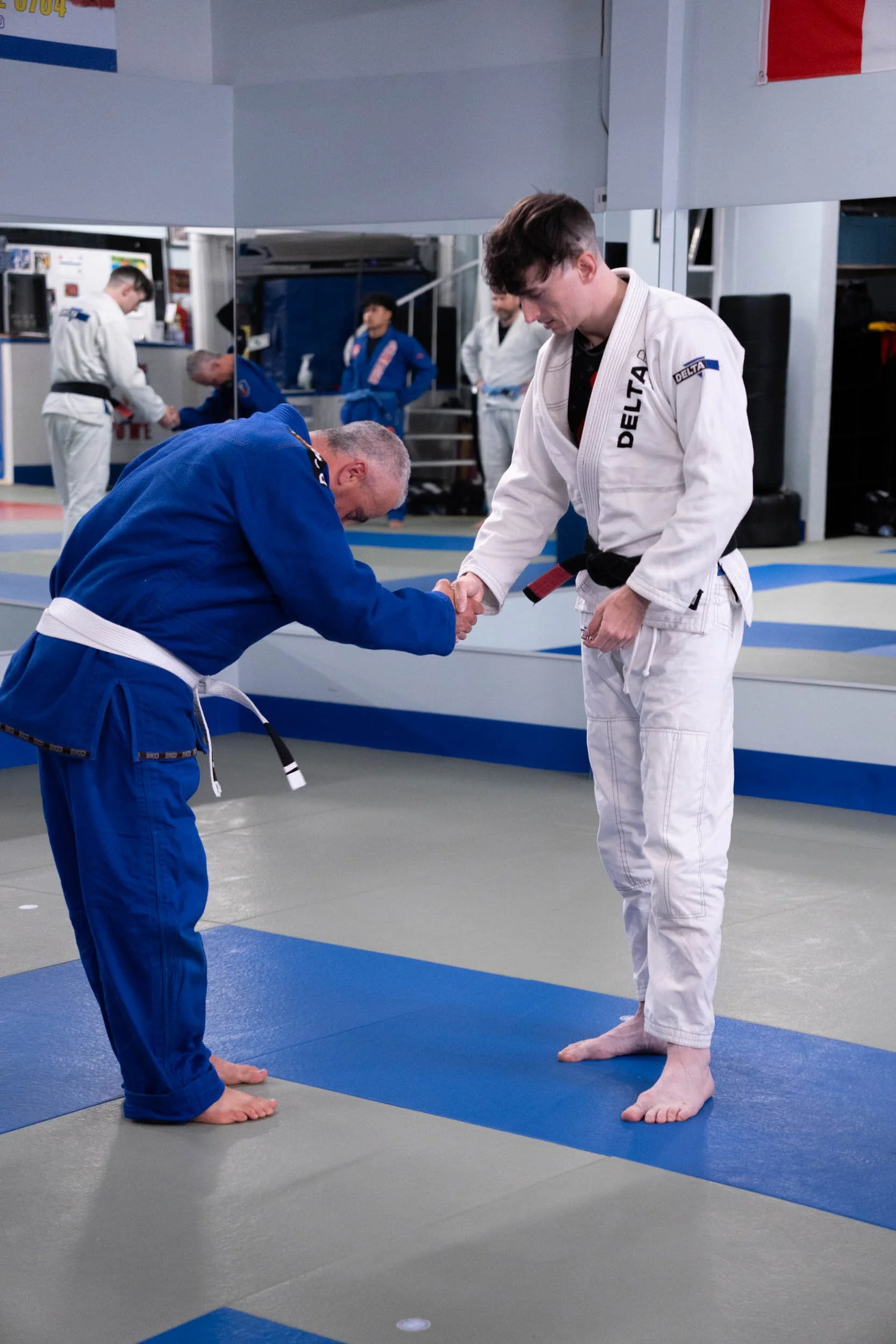
In following with that tradition, this means promotions are given to students when their instructor feels their abilities reflect the new rank.
This includes factors like their ability to learn and apply new techniques, their overall knowledge of techniques and positions, their performance among their peers - not in terms of winning or losing, but showing they can adapt to the challenges they’re presented with - their ability to stay calm and present when sparring, and more.
We do not promote based on attendance, nor do we automatically promote based on the amount of time you’ve been training. We care about your effectiveness, not about ticking arbitrary boxes.
-
This varies widely based on each individual student, their consistency, training frequency, and more. The simple answer is this: like all things in life, you get out of it what you put into it.
Promotions in BJJ are slower than other martial arts, and as a result each stripe and each belt mean that much more.
Using data from over 13,000 users on BeltChecker.com, we see that the average time at each belt is as follows:
White - 2 years, 1 month
Blue - 4 years
Purple - 3 years, 2 months
Brown - 3 years
Our advice to you is to ignore belt ranks entirely. Focus on consistency and improving your skills, and the belts will come on their own in time. They are just a visual indicator of your general skill level, and what matters most is the skills themselves. Instead of asking your instructors when you’re getting your next stripe/belt, ask how you can improve and we’ll be happy to give you personalized support to help you on your way. -
Again, this varies widely depending on the student. How much time they put in, how frequently they train, the effectiveness of their time on the mats, previous martial arts/combat sport experience, etc.
Some have gotten theirs in just 5 years, others spend 30 achieving theirs.
Using the data from BeltChecker.com, the average time it takes to earn a Black Belt is 12 years and 4 months. -
Most BJJ gyms do not have a list of techniques students must learn in order to earn their next rank, as covered earlier. However, we do have a few very simple requirements for promotion at Delta BJJ.
1) You Want Us To Promote You
We strongly encourage all of our students to gain a variety of training experiences at other gyms and with other instructors. However, we also don’t want to step on your other instructors’ toes. You should be promoted by whoever you feel is your primary instructor. If that’s us, we’ll be happy to do so, otherwise we’ll leave that up to the instructor who knows your journey best!
2) We Know Your Skill Level
If you’ve been with us since the beginning of your journey, then we already know where you’re at. However, if you came from another gym, it will take some time for us to get to know your jiu-jitsu knowledge and skill before knowing if you’re ready for a promotion or not.
3) IBJJF Minimum Time Requirements
Many students have a desire to try their hand at competing at some point in their journey. As a result, we do require students to meet the International Brazilian Jiu Jitsu Federation (IBJJF) minimum time requirements at each belt before moving on to the next one in order to ensure they are able to compete at their proper belt rank without issue.
If a student is promoted before hitting this minimum time requirement, they may not be eligible to compete in IBJJF competitions or may be unable to register with the IBJJF at their proper belt rank.
These minimum requirements are quite short, so it’s highly unlikely they will hold you back unless you’re a very high level competitor.
The minimum requirements as of October 12th, 2025 are as follows:
White - None
Blue - 2 Years
Purple - 1.5 Years
Brown - 1 Year
Please see the IBJJF’s website for the most detailed and up to date information on this topic.
That’s it. Pretty simple, right? -
Sadly, no, it doesn’t work that way. Ask coach Connor about the time he got Professor Eric in a heel hook, he can tell you all about that.